Man Versus Food: the trials and tribulations 4000 kcals

1 month ago Dec’s body fat was 13% (reduced from 16% over the three week holiday) and his weight was 101kg. His aim was to increase weight slowly over the next few months for the start of the rugby season. To achieve this:

  • intensive weight lifting schedule, 1-2 sessions/day
  • reduction in running (aerobic) training – burned too many calories, calories needed to build the muscle
  • increase in food calories, aiming for 3600kcal/day

So what do the most recent figures say?

Weight has remained static at 101kg, while fat mass has decreased to 10%, sorry 9.8% (down 3%). This indicates that approximately 3kg of fat has been lost and 3kg of muscle gained. Brilliant, if he was going to pose on the beach all day, however, the men in the driving seat at London Irish, Robbie and Adi, want the weight up! A month ago, using nutrition calculations, his target calorie intake was set at 3600kcal to achieve this weight increase.

Dec’s case illustrates how the ‘textbook’ theory does not always translate in to practise. There are a number of reasons weight has not been increasing. Here are some important points:

  • Weight is static indicating, his body is using up the same calories that he is eating/drinking.
  • Fat is being catabolised (broken down), while weight training is building the muscle. Any extra calories in the body have been used to increase muscle.
  • It is a VERY common phenomenon for food diaries/diet histories to be inaccurate due to misreporting or people changing what they eat either subconsciously/consciously (not necessarily with malicious intent, it’s just human nature). I can verify that Dec has in fact been having 3600kcal (to the point that he is a bit OCD about it).

So in a nutshell, Dec needs to increase his calories even further to gain weight. Adi suggested that Dec increased ‘macros’. Macros is short for macronutrients, a fancy name for carbohydrates, protein and fat. So he just needs to eat more food, about 400kcal more per day. Simple right?

The reality of consuming such a hugh amount of food can be difficult both physically and mentally, not to mention expensive.

Psychologically, it can be very tough for someone who, in the past, has always had to fight hunger for fear of putting on too much weight.

There needs to be a balance between eating ridiculously healthily, and including the less nutritious or ‘treat’ foods in the diet. Unfortunately, as with many other professional sports people, Dec has an ‘all or nothing’ mentality. In the past, if he wanted a chocolate bar, he would go to the shop and return with a Yorkie, a packet of Rolos, a Turkish Delight and a Magnum ice cream. And eat them ALL within an hour. Since improving the quality of his diet, there has been a significant change, for the better, in body composition. In the last 2 months, the apparent healthiness of his diet could also be his downfall, in that it may be preventing him from achieving the desired increase in weight. Dec’s fear is that if he relaxes his diet, he’ll fall back in to the negative behaviour of devouring a whole packet of peanuts or tub of Haagen Dazs. All or nothing.

Despite being a sports dietitian, and obviously ready to give my opinion, and advice, I am wary of being too ‘food police’.  What a nightmare that would be for him (and me), if I was constantly eyeballing what he was eating, and remarking on every morsel. Of course if he wants to we discuss best options, timings, quantities etc. and I help a lot with calculating his intake, but generally I try to back off with my input.

Physically, the shear volume of food/high calorie drinks needs to be fitted in around very intensive training. This morning Dec had fitness testing at 11am, which involved extremely high intensity bursts of running. He cannot have a substantial amount of food sitting in his stomach for this. So he had large breakfast 3-4 hours before to allow time for it to digest, a snack 1-2 hours before, and an easily digestible carbohydrate drink 30 minutes before. Followed by a meal afterwards. The constant need for nutrition is tedious, though something that comes with the job.

So here are some practical solutions for increasing calories in an already food overloaded regimen. Dec came up with most of these himself, most are tweaks to what he already does.

Practical solutions for increasing nutritious calories:

  • thick layer of peanut butter instead of egg with bagel
  • more high calorie snacks, more frequently, so the stomach isn’t too full
  • 2 handfuls of almonds instead of 1 handful
  • banana instead of an apple
  • fruit juice instead of water
  • full fat yoghurt instead of low fat
  • grated cheese on meals
  • tablespoon olive oil in food
  • more regular use a weight gain supplement eg. Kinetica Oat Gain – 2 scoops = 315kcal. Oat Gain Cookies

Here we go again, it’s 3 hours since his last meal. As I sit at the kitchen table typing, he’s here to prepare another 600kcal meal: burger, wrap  and coleslaw. Then it’s off to Sainsbury’s restock the fridge.

Recovery shake

Post workout: providing the perfect balance of protein, carbs, vitamins, minerals, antioxidants and electrolytes.Photo on 2013-07-02 at 14.02

Put the following ingredients in a blender and whizz up!

200ml milk

2 tablespoon natural yoghurt

handful frozen berries

1 banana

tablespoon honey

pinch of salt

Food for Fuel

If you want to improve your athletic performance, increase strength, or perform well in competition/on game day, then it is vital to fuel your exercise sessions well. Timing is as important as type of fuel. (For some people, whose only aim is to lose weight, exercising on an empty stomach may be of benefit).

Here are just a few of the reasons why it is important to eat pre exercise:

  • carbohydrate to provide the muscles with energy
  • protein to repair muscle damage caused during exercise
  • protein & carbohydrate to build new muscle
  • carbohydrate and caffeine to improve concentration

It may sound obvious, but to be used as fuel, food and fluids need to be digested and absorbed in to the body. Ideally, a meal should be eaten 3-4 hours before exercise, with a top up of a smaller snack 1-2 hours before. This snack should be low fibre and low in fat as this allows faster digestion and less likely to cause gastrointestinal discomfort. Anything consumed within an hour of exercise starting should be very quickly absorbed.

For people wanting to improve fitness while losing weight, be careful of increasing overall daily calorie intake. Adding extra food and drinks for fueling purposes won’t help with weight loss, as you want to create an energy deficit (calories used up more than calories eaten/drunk). Instead, redistribute calorie intake through the day, and use lower calorie options eg, fruit, veg, low fat yoghurt, a cup of milky coffee during the 1-2 hours before exercise.

Ideas for pre exercise meals:

3-4 hours before exercise:

  • Pitta/crumpets/toast with jam or honey + flavoured milk
  • Jacket potato & cottage cheese/beans/tuna/chicken
  • Baked beans on toast
  • Breakfast cereal/porridge with milk
  • Bread roll/sandwich/bagel/wrap with cheese/meat/chicken & salad

    image

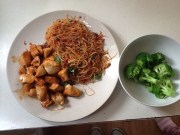
    3-4 hours before: Noodles, chicken stir fry and broccoli

  • Fruit + yoghurt
  • Pasta, rice or noodles with tomato sauce, lean meat eg. chicken, vegetables

1-2 hours before exercise (low fat, low fibre, high carbs and some protein) :

  • Milk shake or Fruit smoothie

    Chocolate milkshake

    1-2 hours before: Chocolate milkshake

  • Sports bars
  • Breakfast cereal with milk
  • Toast with honey/jam
  • Fruit-flavoured yoghurt
  • Fresh fruit
  • Dried fruit
  • Cup of milky coffee (caffeine enhances performance by reducing perception on fatigue, and increasing alertness and concentration)

Early morning sessions: If you train first thing in the morning, it is probably not possible to have a meal 3-4 hours before. In these circumstances, have a good meal the night before, then a snack and fluid 1-2 hours pre exercise eg. breakfast cereal and milk, fruit and cereal bar, smoothie or milkshake. Make sure that you then top up carbohydrate levels during the training session or event with a high carbohydrate drink.

Specific requirements: it is possible to calculate specific amounts of carbohydrate for optimal fuelling eg. 1-4 g/kg consumed 1-4 hr pre-exercise. A dietitian can help you calculate your individual requirements, and translate these in to actual amounts of food.

Everybody responds differently to eating and drinking before exercise. Experiment during training to find out what works best for you. Don’t leave it until the day of a big event to try something new!

Tomato & Lentil soup/sauce

Here is a great recipe for a soup/sauce using tomatoes and lentils that is high in protein, slow release carbs, and full of antioxidants. Especially good for post workout recovery snack/meal! It has just four ingredients and takes about 20 minutes to make.

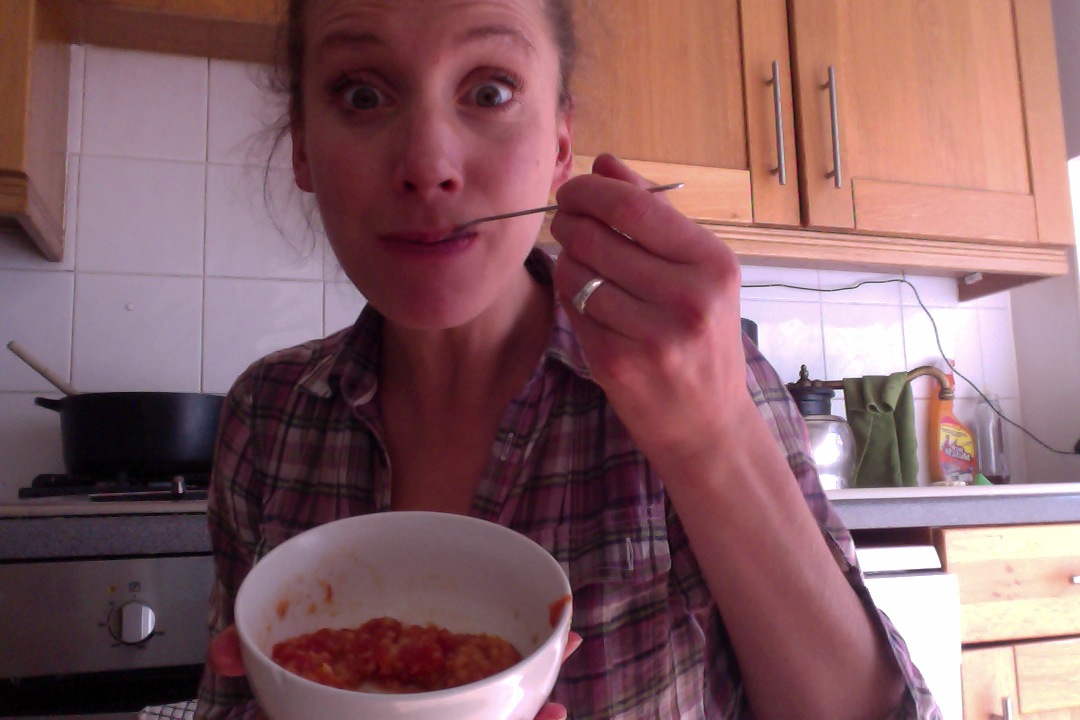
Photo on 25-09-2013 at 12.17 #7

Why’s it so great?

  • the whole pot is 400 kcal, 25g protein and 30g fibre
  • lentils are low GI, meaning the carbohydrate is released slowly, avoiding peaks and troughs in blood sugar levels. Lentils have some iron.
  • high protein makes it filling, so you’ll be less inclined to snack later on
  • tomatoes are high in lycopene, an antioxidant, which may reduce prostate, breast and stomach cancer risk and lower cholesterol. Tomatoes are also packed full of other vitamins e.g. vitamin C, which enhances the absorption of iron in the lentils!
  • it’s cheap……..approximately 80p for the batch
  • add more water for a more liquid soup, or less water for a sauce. Use the sauce as a base for bolognaise (you can use less mince than normal) or on its own as a pasta sauce
  • for those of you in strength training, super charge with protein by adding some chopped up chicken breast or tuna.

It is incredibly filling. I usually have about half for lunch and the other half as a snack in the afternoon. If I’m pushed for time, I leave out the onion.

Here’s the recipe:

tin chopped tomatoes

100g red lentils (dry)    

1 onion

Chicken/beef stock cube made up to approx 300ml with boiling water

Chop the onion, put in saucepan with lentils and stock. Bring to boil, turn heat down and simmer for about 20 minutes. Add more water if necessary. Add the tin of tomatoes. For extra flavour add a squirt of tomato ketchup, a dash of worcester sauce, and a sprinkle of cumin. For a smoother soup or sauce, use a blender.