Be good to yourself…..food demons BOG OFF!!

We all know the benefits of being ‘healthy’. But if living a healthy lifestyle was easy, then everyone would be doing it, right? On paper, eating nutritious food and taking regular exercise is a no brainer. So what’s the problem?

I hate the thought of food being categorised as ‘healthy’ or ‘unhealthy’. I believe no food should be demonised, however it’s an unavoidable fact  that some foods nourish our bodies more than others. Nobody is obliged to be healthy all the time. We all have unhealthy habits, and these are up to us as individuals with minds of our own. Happiness is what matters, not a social standard of what is deemed as healthy.

If you really do feel content with your diet, whether you live on burgers and chips or have a nutritionally brilliant diet, then that’s nobody’s business but your own. If you feel that you would be happier by making changes to what you eat, but find it difficult, then here are some motivation ideas that you might find helpful…..

  • You’ll never regret choosing the more positive option eg. yoghurt and strawberries over a bar of chocolate. Before making a choice, ask how you will feel in an hour. Think of how great you will feel psychologically and physically after a whole week or month of making daily positive choices.
  • “I deserve this, I’ve had a hard day”. Try not to use food as a reward, to relieve stress or to make you happy. Food is primarily fuel for our bodies. Once again think longer term….how will you feel in an hour after eating half (or a whole) tub of ice cream? How much better would you feel rewarding yourself in other ways eg. walk to the shop after dinner to buy yourself a magazine or a tub of cherries to munch on the way home.
  • We often tell ourselves that we can’t do without something that we have regularly. A common thing to hear is “I’m addicted to chocolate” or “I’m addicted to bread”. Your mind is powerful in both positive and negative ways. If you want to change your habit, turn the negative in to the positive. By saying: “I’m addicted, therefore I can’t do anything about it”, you are essentially removing your responsibility for what you feed yourself.  Tell yourself, “I am in control of my thoughts, I am in control of what I buy, and I am in control of what I feed my body.”
  • Sometimes, it’s as if the biscuit tin is calling you, drawing your hand towards it like a magnet. If it helps, imagine a little demon on your shoulder. It is telling you to have another biscuit and, go on just one more, and, well, you may as well finish the lot. Tell it in the strongest possible way (!) to bog off and to stop sabotaging your efforts.
  • If you can’t resist temptation, then make things easier on yourself by not having the foods you are trying to avoid in the cupboard or fridge. Get. Rid. Of. It. People often tell me, ‘but it’s for the kids/ visitors’. Too much of it is not good for you and it’s not good for them either. Replace with healthier alternatives.

Ultimately, we have to take responsibility for ourselves. Isn’t it a great thing that we can!?

Breakfast – fuelling the Team Sky way

tour-de-france-logo

Bonjour, bonjour mes amies!! The Tour de France is upon us once again! For Tour fans in the Danaher house, it’s one of those annual events that marks another summer, another pre-season, and the passing of another year.

These days, we record the evening highlights programme to watch after the kid’s bedtime. We let them watch it with us once, however, they like to ask questions. Question after question after question. Insane questions, so the family viewing was knocked on the head.

Dec doesn’t like knowing the result before sitting down to watch, so throughout the day, if the radio in the kitchen is on (5 Live, pretty much ALL day), I get terrorised by him yelling in a dreadful panic, “TURN IT OFF TURN IT OFF!!!!” when there’s a sports update.

The Tour de France is the ultimate in testing cyclists’ fitness to the extreme. It lasts three weeks and sees ridiculously fit cyclists riding ridiculously long distances up ridiculously steep mountains. It always has unpredictable and sometimes comedy moments…….highlight so far this year was a team bus getting wedged under the finish line. The stages place enormous stress on the body. The hours spent in the saddle makes fuelling with enough calories, carbs, protein and fluid a real challenge. Tour cyclists require about 6000kcal per day (a normal intake would be about 2500kcal)! Nutrition to fuel the race, as well as to ensure recovery in the short time until the next stage is a hard job.

820_w475_b

Head of Nutrition at Team Sky, Nigel Mitchell, has the task of ensuring the boys have primed their bodies with optimum nutrition for each race. The aim for all cyclists should be to start races with carbohydrate and fluid stores well stocked. Breakfast is high calorie, carb and protein, from nutritious food sources. Team Sky also has a chef who travels with them.

Here is Nigel’s breakfast strategy for his team:

Hydration – Nigel uses a ‘Positive Hydration Strategy’, this means drinking enough fluids to ensure dehydration does not occur. Dehydration increases body temperature, resulting in increased heart rate, meaning the heart is having to work harder. Dehydration will also affect energy production and concentration.

images-1

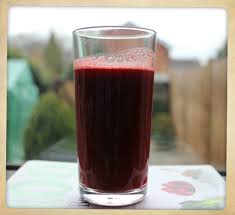
Pre-race: Between waking, and the start of the race (approximately 4-5 hours) 3-4 litres of fluid, from diluted fruit juices, vegetable juices and water. As well as fluid, juices also provide a source of vitamins, minerals and antioxidants, with out the bulk of whole fruit and veg.

Breakfast:

Nigel ensures his team have their pre-race meal 3-4 hours before getting in the saddle. On the menu each morning:

Porridge: oats, quinoa, milk, water, cinnamon, topped with banana puree & yoghurt, and some berries. High in complex carbohydrates for slow and steady release of energy.

Omelette: eggs are high in protein to help prevent muscle breakdown during the race.

Bread: wholemeal – more complex carbohydrates

Fresh fruit & vegetable juice: more of this stuff, providing fluid for hydration and to bump up vitamin, mineral and antioxidant intake.

So with their bodies well stocked with fuel for the race, the cyclists also have the important psychological advantage of knowing they are ready for the punishing ride over the next 6 hours. Nutritionist Nigel’s next challenge is to push enough fluid and calories while they are in the saddle………….

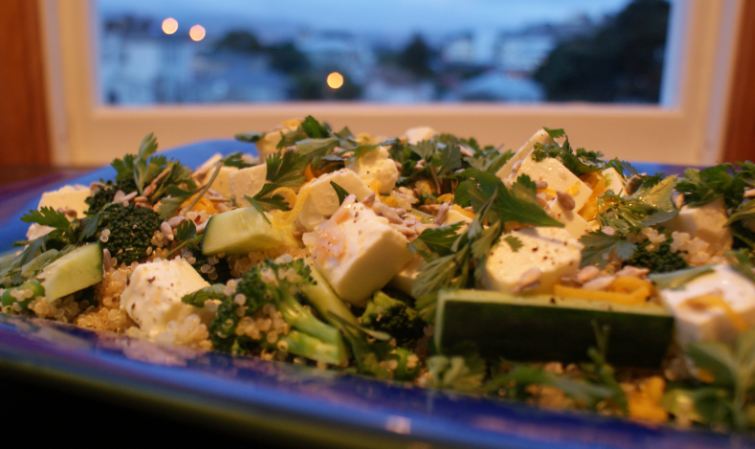
Super Food Salad

Super Food Salad

superfood salad

Photo doesn’t do it justice!

This recipe is adapted from the Leon restaurant recipe book. We have this every week, usually with salmon or sausages. I make a bit extra so there’s some in the fridge for lunch the next day.

images

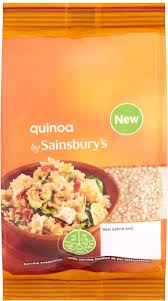
Dried Quinoa

Quinoa (pronounce keen-wah) is high in carbohydrate, and has a slightly nutty taste and makes a nice change to rice or cous cous. Unusually for a non-meat/dairy food it contains complete protein, which means it as all the amino acids, which are the building blocks of protein. It’s a myth that it’s high in protein. As a comparison, quinoa has about 8g/100g, while most meat has about 20-30g/100g.

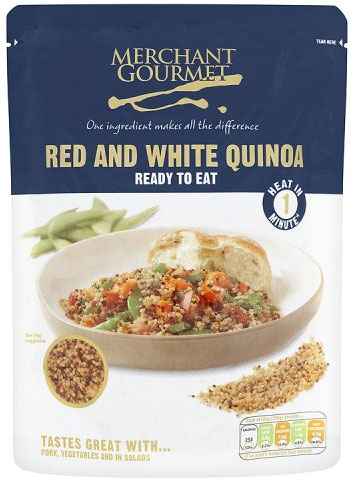
Ready to eat

Ready to eat

Quinoa can be bought in most supermarkets. ready to eat or dried. If you buy dried (much better value) then you need to cook it by putting in a saucepan with enough cold water to cover it, bring to boil, then simmer for about 20 minutes with the lid on, keeping on eye on it so it doesn’t dry out.

To reduce the calories:

Leave the feta out, and add extra veggies. It will lower the protein content of the recipe, but if you’re having it with a portion of fish/chicken/meat etc. this won’t matter. Oil has 100kcal per tablespoon, so you can either reduce the olive oil to 1-2 tbsp, or just use lemon juice on it’s own.

So here’s the recipe. Just toss the ingredients together and mix in the dressing!

100g cooked quinoa

100g cooked broccoli

100g frozen peas, thawed

100g feta cheese, crumbled

¼ cucumber, cut in to thin sticks

handful pumpkin and sunflower seeds (toasted in the grill)

handful chopped parsley

handful chopped mint

 Dressing:

2 tbsp lemon juice

4 tbsp olive oil

Should you exercise on an empty stomach?

The theory behind this is that by not eating before exercise, your body burns a higher percentage of fat. In a recent study at Northumbria University (Gonzalez et al, 2013), 12 athletes either fasted or had breakfast before a moderate intensity treadmill workout. The fasters burned 20% more fat than the breakfast eaters. Interestingly, throughout the rest of the day, the fasters ate less and did not have an increased appetite to compensate for lack of food pre exercise.

Another study (Proeyen et al, 2011) found that exercising on an empty stomach during endurance training caused metabolic adaptations to the muscles, so that they burned fat in preference to carbohydrate.

So, if the reason you are exercising is purely to lose weight, then an empty stomach may benefit you. However, in practise, if you find you lack energy/dizzy and are unable to exercise for as long or as hard, then the resulting decrease in calories burned may not be worth it.

As with many aspects of nutrition, there is no definite right or wrong, black or white. Find what works for you!

For those wanting to build muscle or improve athletic performance, then food intake pre exercise is vital to fuel the training session, and to facilitate the anabolic process of increasing muscle mass and increasing endurance (Chryssanthopoulos et al, 2002, Neufer et al,1987.)


Gonzalez J et al. (2013) Breakfast and exercise contingently affect postprandial metabolism and energy balance in physically active males. British Journal of Nutrition 23:1-12

Van Proeyen K et al. (2011) Beneficial metabolic adaptations due to endurance exercise training in the fasted state Journal of Applied Physiology 110 (1): 236–245.

Chryssanthopoulos, C. et al. (2002) The effect of a high carbohydrate meal on endurance running capacity International Journal of Sports Nutrition 12, 157–71.

Neufer P et al. (1987) Improvements in exercise performance: effects of carbohydrate feedings and diet. Journal of Applied Physiology, 62, 983–988.

Summer oat breakfast

Oats are the perfect healthy breakfast. High in fibre, and filling. Porridge is the traditional way of eating them, but in the summer months a hot breakfast may not seem appealing.

This recipe uses oats, milk and yoghurt, as well as which ever extra ingredients you would like to add. It doesn’t require any cooking, as it is refrigerated over night to allow the oats to soak up the milk and yoghurt. Result: a super creamy, cool, filling breakfast. Lovely on it’s own, or you can add banana, berries, cinnamon, stewed apple, pumpkin seeds……or anything else you can think of!

Mix the following ingredients together:

40g oats (about 1/2 a cup or a handful)

150ml milk

100ml yoghurt

Cover and put the the fridge overnight. Add the extra ingredients before serving. Ta da. Summer oat breakfast ready for you in the morning.

Approx 280 kcal, 38g carbs, 18g protein

Deirdre’s Coleslaw

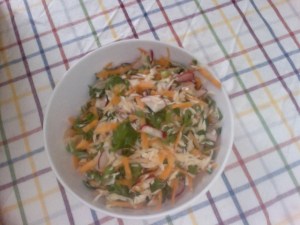
This is a recipe from Deidre, my husband’s cousin in Dublin……it’s a healthier version of the one I usually make (cabbage, carrot, light mayo and yoghurt), and lots more flavour:

Deirdre says: “When making “coleslaw”, I like to leave mayo out completely.Photo on 2013-06-18 at 16.38 #2

Finely chop cabbage, radish, spring onion

grate carrots

half handful of coriander

a squeeze of lime juice

half a squeezed orange

Here’s how it looks. Tastes lovely too, zingy, sweet at light. Thanks Deirdre!

Monday – training day

Today’s calorie aim for Dec was 3700 kcal as there were 2 training sessions (weights and running), so the extra kcal, protein and carbs are to compensate for the extra energy used during the sessions, and to promote muscle gain.

Contrary to popular belief, carbs are as important as protein for muscle gain. (More on eating for strength in a future blog!)

7am Breakfast: porridge made with milk/water, sugar and raisins

9am Carb/protein/creatine shake.

Running: Carb/protein shake

Post weights snack: Museli bar

12pm lunch at work: steak potatoes broccoli

1pm snack: yoghurt & dried berries

Weights: carb/protein shake

post weights: protein shake

snack: 4pm tin of tuna, light mayo, wrap

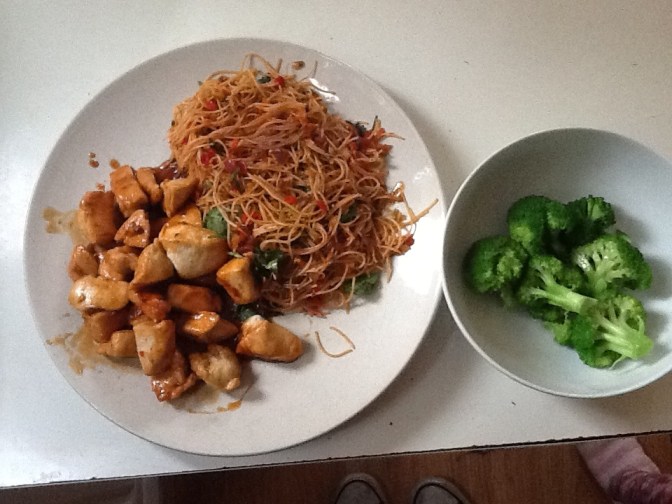
7.30: dinner – 350g chicken stir fried in soy sauce and honey; rice noodles with finely chopped red pepper, red onion, coriander stalks (dressing: 1 tbsp sesame oil, 1 tbsp soy sauce, 1tsp fish sauce, juice of one lime). Broccoli.

This portion: chicken (450kcal, 80g protein, 0g carbs) with rice noodles & veg (250kcal, 6g protein, 50g carbs) Total: 700kcal, 86g protein, 50g carbs

Re the broccoli. Unfortunately, public admission of the this obsession is not humiliating enough for him to change to alternative greenery.

8pm green shake – this stuff is vile and tastes like the smell of manure.

Photo on 2013-06-18 at 06.24

It must be a Man Test. Just eat some spinach for goodness sake, or more broccoli.


Dec was spot on with his calorie aim of 3700 kcal today.  There is a fairly heavy reliance on shakes to meet calorie, carb and protein requirements. Although the nutrient intake goals could have been met with food alone, with work, travel, kids etc, not to mention the exhaustion from training, thinking about shopping, preparing and eating food every few hours can be beyond even the most dedicated.