Breakfast – fuelling the Team Sky way

tour-de-france-logo

Bonjour, bonjour mes amies!! The Tour de France is upon us once again! For Tour fans in the Danaher house, it’s one of those annual events that marks another summer, another pre-season, and the passing of another year.

These days, we record the evening highlights programme to watch after the kid’s bedtime. We let them watch it with us once, however, they like to ask questions. Question after question after question. Insane questions, so the family viewing was knocked on the head.

Dec doesn’t like knowing the result before sitting down to watch, so throughout the day, if the radio in the kitchen is on (5 Live, pretty much ALL day), I get terrorised by him yelling in a dreadful panic, “TURN IT OFF TURN IT OFF!!!!” when there’s a sports update.

The Tour de France is the ultimate in testing cyclists’ fitness to the extreme. It lasts three weeks and sees ridiculously fit cyclists riding ridiculously long distances up ridiculously steep mountains. It always has unpredictable and sometimes comedy moments…….highlight so far this year was a team bus getting wedged under the finish line. The stages place enormous stress on the body. The hours spent in the saddle makes fuelling with enough calories, carbs, protein and fluid a real challenge. Tour cyclists require about 6000kcal per day (a normal intake would be about 2500kcal)! Nutrition to fuel the race, as well as to ensure recovery in the short time until the next stage is a hard job.

820_w475_b

Head of Nutrition at Team Sky, Nigel Mitchell, has the task of ensuring the boys have primed their bodies with optimum nutrition for each race. The aim for all cyclists should be to start races with carbohydrate and fluid stores well stocked. Breakfast is high calorie, carb and protein, from nutritious food sources. Team Sky also has a chef who travels with them.

Here is Nigel’s breakfast strategy for his team:

Hydration – Nigel uses a ‘Positive Hydration Strategy’, this means drinking enough fluids to ensure dehydration does not occur. Dehydration increases body temperature, resulting in increased heart rate, meaning the heart is having to work harder. Dehydration will also affect energy production and concentration.
images-1

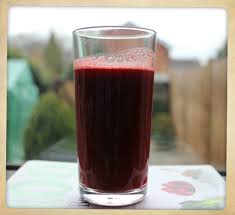
Pre-race: Between waking, and the start of the race (approximately 4-5 hours) 3-4 litres of fluid, from diluted fruit juices, vegetable juices and water. As well as fluid, juices also provide a source of vitamins, minerals and antioxidants, with out the bulk of whole fruit and veg.

Breakfast:

Nigel ensures his team have their pre-race meal 3-4 hours before getting in the saddle. On the menu each morning:

Porridge: oats, quinoa, milk, water, cinnamon, topped with banana puree & yoghurt, and some berries. High in complex carbohydrates for slow and steady release of energy.

Omelette: eggs are high in protein to help prevent muscle breakdown during the race.

Bread: wholemeal – more complex carbohydrates

Fresh fruit & vegetable juice: more of this stuff, providing fluid for hydration and to bump up vitamin, mineral and antioxidant intake.

So with their bodies well stocked with fuel for the race, the cyclists also have the important psychological advantage of knowing they are ready for the punishing ride over the next 6 hours. Nutritionist Nigel’s next challenge is to push enough fluid and calories while they are in the saddle………….
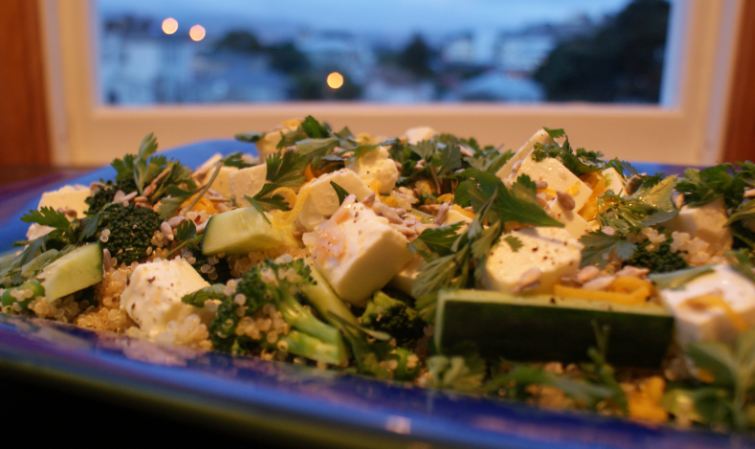
Super Food Salad

Super Food Salad

superfood salad

Photo doesn’t do it justice!

This recipe is adapted from the Leon restaurant recipe book. We have this every week, usually with salmon or sausages. I make a bit extra so there’s some in the fridge for lunch the next day.

images

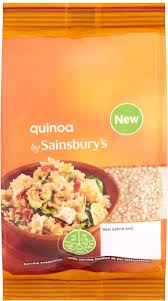
Dried Quinoa

Quinoa (pronounce keen-wah) is high in carbohydrate, and has a slightly nutty taste and makes a nice change to rice or cous cous. Unusually for a non-meat/dairy food it contains complete protein, which means it as all the amino acids, which are the building blocks of protein. It’s a myth that it’s high in protein. As a comparison, quinoa has about 8g/100g, while most meat has about 20-30g/100g.

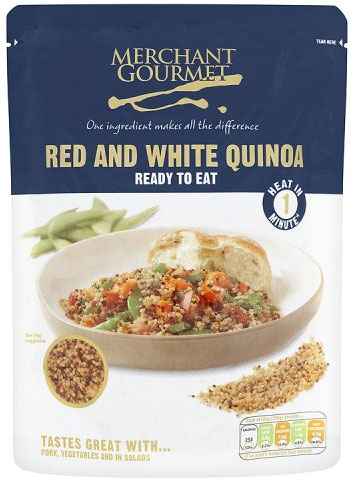
Ready to eat

Ready to eat

Quinoa can be bought in most supermarkets. ready to eat or dried. If you buy dried (much better value) then you need to cook it by putting in a saucepan with enough cold water to cover it, bring to boil, then simmer for about 20 minutes with the lid on, keeping on eye on it so it doesn’t dry out.

To reduce the calories:

Leave the feta out, and add extra veggies. It will lower the protein content of the recipe, but if you’re having it with a portion of fish/chicken/meat etc. this won’t matter. Oil has 100kcal per tablespoon, so you can either reduce the olive oil to 1-2 tbsp, or just use lemon juice on it’s own.

So here’s the recipe. Just toss the ingredients together and mix in the dressing!

100g cooked quinoa

100g cooked broccoli

100g frozen peas, thawed

100g feta cheese, crumbled

¼ cucumber, cut in to thin sticks

handful pumpkin and sunflower seeds (toasted in the grill)

handful chopped parsley

handful chopped mint

 Dressing:

2 tbsp lemon juice

4 tbsp olive oil

Food for Fuel

If you want to improve your athletic performance, increase strength, or perform well in competition/on game day, then it is vital to fuel your exercise sessions well. Timing is as important as type of fuel. (For some people, whose only aim is to lose weight, exercising on an empty stomach may be of benefit).

Here are just a few of the reasons why it is important to eat pre exercise:

  • carbohydrate to provide the muscles with energy
  • protein to repair muscle damage caused during exercise
  • protein & carbohydrate to build new muscle
  • carbohydrate and caffeine to improve concentration

It may sound obvious, but to be used as fuel, food and fluids need to be digested and absorbed in to the body. Ideally, a meal should be eaten 3-4 hours before exercise, with a top up of a smaller snack 1-2 hours before. This snack should be low fibre and low in fat as this allows faster digestion and less likely to cause gastrointestinal discomfort. Anything consumed within an hour of exercise starting should be very quickly absorbed.

For people wanting to improve fitness while losing weight, be careful of increasing overall daily calorie intake. Adding extra food and drinks for fueling purposes won’t help with weight loss, as you want to create an energy deficit (calories used up more than calories eaten/drunk). Instead, redistribute calorie intake through the day, and use lower calorie options eg, fruit, veg, low fat yoghurt, a cup of milky coffee during the 1-2 hours before exercise.

Ideas for pre exercise meals:

3-4 hours before exercise:

  • Pitta/crumpets/toast with jam or honey + flavoured milk
  • Jacket potato & cottage cheese/beans/tuna/chicken
  • Baked beans on toast
  • Breakfast cereal/porridge with milk
  • Bread roll/sandwich/bagel/wrap with cheese/meat/chicken & salad

    image

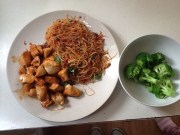
    3-4 hours before: Noodles, chicken stir fry and broccoli

  • Fruit + yoghurt
  • Pasta, rice or noodles with tomato sauce, lean meat eg. chicken, vegetables

1-2 hours before exercise (low fat, low fibre, high carbs and some protein) :

  • Milk shake or Fruit smoothie

    Chocolate milkshake

    1-2 hours before: Chocolate milkshake

  • Sports bars
  • Breakfast cereal with milk
  • Toast with honey/jam
  • Fruit-flavoured yoghurt
  • Fresh fruit
  • Dried fruit
  • Cup of milky coffee (caffeine enhances performance by reducing perception on fatigue, and increasing alertness and concentration)

Early morning sessions: If you train first thing in the morning, it is probably not possible to have a meal 3-4 hours before. In these circumstances, have a good meal the night before, then a snack and fluid 1-2 hours pre exercise eg. breakfast cereal and milk, fruit and cereal bar, smoothie or milkshake. Make sure that you then top up carbohydrate levels during the training session or event with a high carbohydrate drink.

Specific requirements: it is possible to calculate specific amounts of carbohydrate for optimal fuelling eg. 1-4 g/kg consumed 1-4 hr pre-exercise. A dietitian can help you calculate your individual requirements, and translate these in to actual amounts of food.

Everybody responds differently to eating and drinking before exercise. Experiment during training to find out what works best for you. Don’t leave it until the day of a big event to try something new!

Should you exercise on an empty stomach?

The theory behind this is that by not eating before exercise, your body burns a higher percentage of fat. In a recent study at Northumbria University (Gonzalez et al, 2013), 12 athletes either fasted or had breakfast before a moderate intensity treadmill workout. The fasters burned 20% more fat than the breakfast eaters. Interestingly, throughout the rest of the day, the fasters ate less and did not have an increased appetite to compensate for lack of food pre exercise.

Another study (Proeyen et al, 2011) found that exercising on an empty stomach during endurance training caused metabolic adaptations to the muscles, so that they burned fat in preference to carbohydrate.

So, if the reason you are exercising is purely to lose weight, then an empty stomach may benefit you. However, in practise, if you find you lack energy/dizzy and are unable to exercise for as long or as hard, then the resulting decrease in calories burned may not be worth it.

As with many aspects of nutrition, there is no definite right or wrong, black or white. Find what works for you!

For those wanting to build muscle or improve athletic performance, then food intake pre exercise is vital to fuel the training session, and to facilitate the anabolic process of increasing muscle mass and increasing endurance (Chryssanthopoulos et al, 2002, Neufer et al,1987.)


Gonzalez J et al. (2013) Breakfast and exercise contingently affect postprandial metabolism and energy balance in physically active males. British Journal of Nutrition 23:1-12

Van Proeyen K et al. (2011) Beneficial metabolic adaptations due to endurance exercise training in the fasted state Journal of Applied Physiology 110 (1): 236–245.

Chryssanthopoulos, C. et al. (2002) The effect of a high carbohydrate meal on endurance running capacity International Journal of Sports Nutrition 12, 157–71.

Neufer P et al. (1987) Improvements in exercise performance: effects of carbohydrate feedings and diet. Journal of Applied Physiology, 62, 983–988.

8 essential tips for weight loss (and feeling fab!)

 The key to a healthy weight and feeling fabulous: 8 essential tips………

  1. Aim for small changes that you can sustain longterm, rather than a quick fix diet for a few days or weeks. Think “where do I want to be in a year”, rather than, “I want to lose a stone in 2 weeks”
  2. Listen to you body. Don’t starve…..low blood sugar levels will affect your concentration and make you grumpy. For most people, this would mean eating at 3 meals a day, with a snack in between. Eat until satisfied, not stuffed.
  3. Nutrition Basics – get the foundations of your meals right, and the rest shall follow! Always try to have protein at each meal, a fist full size of wholegrain carbs, and 1/2 a plate of veg or some fruit.
  4. Eat Breakfast– if you don’t feel like eating first thing in the morning, have something with in an hour or two of waking.
  5. Have Healthy Snacks to avoid becoming ravenous. Don’t skip meals to try to cut calories. It may make you feel virtuous at the time, but you are more likely to snack on high calorie foods or overeat unhealthy choices at your next meal.
  6. Be aware of what fluids you are drinking – frappacinos, non-diet fizzy drinks, fruit juice etc. can add 100s of calories to you daily intake. Replace with low calorie drinks eg. a cup of tea, americano, small skinny latte herbal, tea, water.
  7. Choose wholegrain carbohydrates ie. wholemeal bread, brown rice, oats. These make you feel fuller for longer. They also blunt rises in insulin (insulin promotes fat storage).
  8. Plan ahead, so that you know that you will have access to something healthy to eat. If you are not at home, always have a healthy snack with you in your bag or in your desk drawer at work.

Summer oat breakfast

Oats are the perfect healthy breakfast. High in fibre, and filling. Porridge is the traditional way of eating them, but in the summer months a hot breakfast may not seem appealing.

This recipe uses oats, milk and yoghurt, as well as which ever extra ingredients you would like to add. It doesn’t require any cooking, as it is refrigerated over night to allow the oats to soak up the milk and yoghurt. Result: a super creamy, cool, filling breakfast. Lovely on it’s own, or you can add banana, berries, cinnamon, stewed apple, pumpkin seeds……or anything else you can think of!

Mix the following ingredients together:

40g oats (about 1/2 a cup or a handful)

150ml milk

100ml yoghurt

Cover and put the the fridge overnight. Add the extra ingredients before serving. Ta da. Summer oat breakfast ready for you in the morning.

Approx 280 kcal, 38g carbs, 18g protein

Deirdre’s Coleslaw

This is a recipe from Deidre, my husband’s cousin in Dublin……it’s a healthier version of the one I usually make (cabbage, carrot, light mayo and yoghurt), and lots more flavour:

Deirdre says: “When making “coleslaw”, I like to leave mayo out completely.Photo on 2013-06-18 at 16.38 #2

Finely chop cabbage, radish, spring onion

grate carrots

half handful of coriander

a squeeze of lime juice

half a squeezed orange

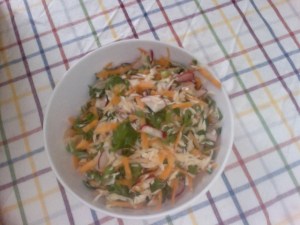
Here’s how it looks. Tastes lovely too, zingy, sweet at light. Thanks Deirdre!