Pre season – even more food, and first game at Nottingham

Pre season training has always been pretty full on. In the Rugby Union calendar, June to August is a time for pushing fitness, strength and skills to prepare for the playing season ahead. With the first warm up game next week against Nottingham, there has been more emphasis on ‘contact’ sessions in preparation for actual games, rather than a focus on fitness eg. running hills. Dec likens it to getting beaten up on a daily basis.

securedownload-3

Day off lunch at GBK  800kcal – stopped the chips, fried onion rings and milkshake this year.

At 33, retirement is on the horizon, and the cross over to life beyond playing is taking root. Dec is is embarking on a coaching career, so after his own day of training, he’s passing on what he has learnt over the past fourteen years to the academy lads at London Irish.  It’s a long day, and hard work both physically and mentally. But like anything, if you do something you love it is a pleasure and a privilege rather than a chore.

Oddly, for an old guy (33), Dec is feeling pretty good. Apart from the usual longterm niggles originating from two ACL repairs in two consecutive years, he feels that he is in the shape of his life. It’s always tricky to put this down to any one reason. One of the main factors is that after 14 years of messing around with various diets and supplements, he is taking the sensible, and, sorry folks, ‘boring’ avenue of eating healthy balanced meals. Don’t get me wrong, diets or lifestyles such as low carbing or the Paleo diet have their merits, and can work for many, however, for most athletes in hard training they won’t enable optimal performance and can even impact on susceptibility to illness.. As well as the good food, and obviously the daily training, rest is another important aspect. So no late nights, and as much of a lie in as possible!

As he is still trying to gain weight, total daily intake now needs to be in excess of 4200kcal. That’s a lot of food! This is where sports supplements would come in very useful, but Dec is reluctant to rely on these, preferring to reap the benefits of real food, benefits that a powder mixed with water simply cannot replicate. Practically, this can be tough, requiring careful planning of what and when he is going to eat.

Here are the current dietary regimen principles:

  • regular meals – roughly every 3 hours, that’s 6 meals to spread the food throughout the day and timed around training sessions
  • at least 700kcal per meal
  • not excluding any food group eg. carbohydrateWhen training, carbs are your friend!
  • adding extra calories using nutrient dense foods eg. olive oil (100kcal per tablespoon), extra nuts & seeds added to recipes, lashings of peanut butter on bagels, avocados, grated cheese on top of meals
  • using supplements when necessary – a carb/protein recovery drink during weight training when eating is not possible, followed by a meal asap after the session

Here’s what he had yesterday (all meals, one serving with no seconds!):

7am: large bowl porridge, 1/2 bagel with butter, jam, peanut butter

10am: meal at work – pork, mashed potatoes, vegetables

image

Yoghurt, nus and apple

1pm – meal at work – beef fajitas

4pm: yoghurt, nuts, apple, supplement bar

7pm: meal at home – chicken, spinach, cherry tomatoes and puy lentils with brown basmati rice

image

Tuna mayo wrap

10pm: tuna mayo in a wrap with pepper and spring onions

So it’s just a few days until the first warm up game oop north (that’s anywhere past the M25 for Dec). For me, every game is a nerve racking experience. The phone call that comes about 30 minutes after the final whistle is always eagerly anticipated, so that I can breathe a sigh of relief that he has come through relatively unscathed (black eyes and wounds that can be sewn up pitch side don’t count as proper injuries!)
Pre season training – a day in the life……

7 weeks in to pre season training, and we’re starting to feel the physical strain. Pre season (June-August) is the time when fitness and strength training are pushed to the extreme in preparation for the playing season ahead. I say ‘we’re’ starting to feel the strain as having a husband in pre season training is like adding another child to the equation. His exhaustion at the end of the day renders him pretty much helpless!

This morning, Monday 22nd July, sees that start of ‘Over-load Week’, when the boys are pushed even more physically, with the reward of a week off from Sunday. As I sit here typing at 6am, Dec’s alarm is jolting him out of his comatose state. With the first training session at 7.15am, he needs to be up with enough time to fit in the first meal to allow it to digest. Here’s the schedule for today:

7.15am: 45 minutes weights (‘hypertrophy’ short, sharp and intense lifting, to increase muscle mass)

8am: breakfast

8.30am: stretching session

10am: 1 hour rugby training

11.30am: 1/2 hour conditioning (fitness/running)

12pm: lunch

2.30pm: Weights (legs)

4pm: afternoon meal

4.30pm: physio/massage

6ish +: return home

So it’s a long day of weights, rugby and fitness training. The forecast for today is 32 degrees C…………..so on top of food and snacks, fluid, fluid, fluid is as important to maintain hydration.

After the long day at the Sunbury training ground, Dec will return to (ahem) our tranquil home. Perhaps I will rephrase that. Dec will return home to the tears and tantrums lively and spirited debates between our two girls (6 and 3), and our 1 year old toddler, who is going through a clingy/moaning phase. All the poor man wants to do is just sit down and zone out (reminds me of that quote from Winnie the Pooh: “Sometimes I sits and thinks, sometimes I just sits).

With 3 kids entertain, shopping, cooking, cleaning etc. etc. an extra body sitting near comatose on the sofa can be, to be polite, frustrating. However, I have to remind myself that recovery and rest are a fundamental phase of training, as important as the physical sessions throughout the day.

The huge calorie intake needed to meet the requirements of the extra physical activity AND to promote weight gain, can be tricky to achieve. Even with a personal dietitian who also happens to be his wife at his disposal.

I always say that an athlete can meet their nutritional needs using real food, with supplements eg. protein/recovery drinks/bars, used to support the diet if necessary. Real food gives a multitude of vitamins, minerals, antioxidants, phytochemicals, fibre, fatty acids, as well as probably many other substances that science not discovered yet. A manufactured product simply cannot replace a meal for nutrition.

Dec, being Dec, has taken this on board, wanting most of his nutrition to come from food, with recovery/energy drinks used a few times during training. In theory, this is music to the ears of a dietitian. However, in practise this means 5 meals per day, which is tedious (shopping, cooking, cleaning up), not to mention expensive.

Rob, the Strength & Conditioning coach at London Irish, has the boys on strict diets to meet their various nutrition and training needs. Dec’s aim is to increase weight from 100kg to approximately 105kg, while maintaining body fat at 10%. He’s on target, having upped the weight to 102.5kg (that half kilo is VERY important!)

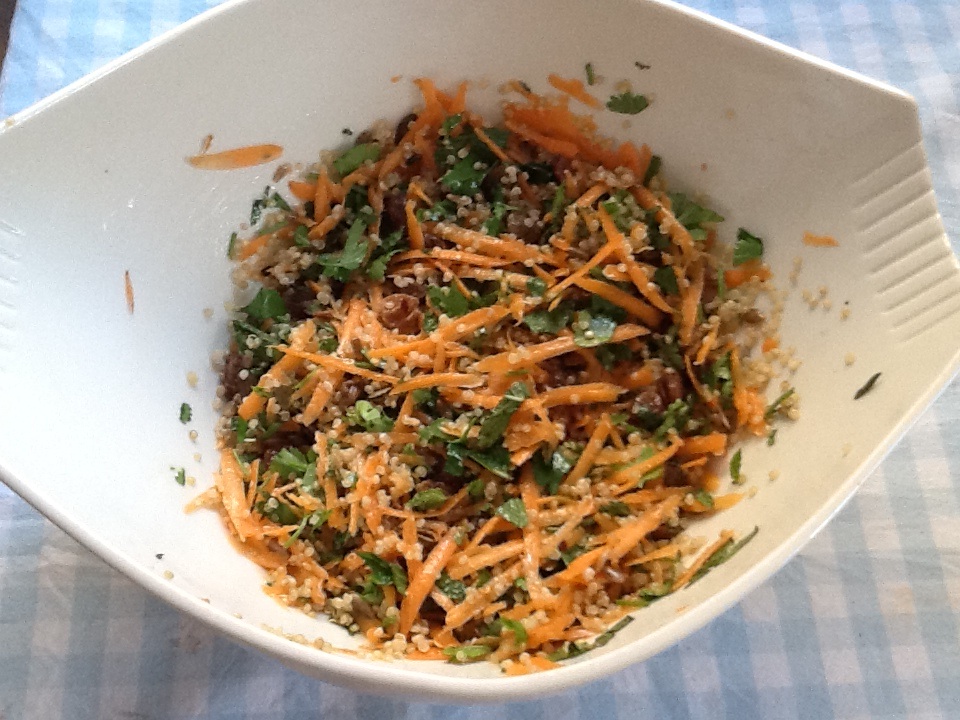
Meals yesterday: porridge; bagel & scrambled eggs; salt beef ciabatta; pasta with pesto, chicken, pepper & spring onion; salmon, rice, happy carrot salad; wrap with chicken & coleslaw.

happy carrots

happy carrots

Snacks/training: apples, yoghurts, almonds, recovery drinks, energy drinks.

image

almonds, yoghurt, apple

Man Versus Food: the trials and tribulations 4000 kcals

1 month ago Dec’s body fat was 13% (reduced from 16% over the three week holiday) and his weight was 101kg. His aim was to increase weight slowly over the next few months for the start of the rugby season. To achieve this:

  • intensive weight lifting schedule, 1-2 sessions/day
  • reduction in running (aerobic) training – burned too many calories, calories needed to build the muscle
  • increase in food calories, aiming for 3600kcal/day

So what do the most recent figures say?

Weight has remained static at 101kg, while fat mass has decreased to 10%, sorry 9.8% (down 3%). This indicates that approximately 3kg of fat has been lost and 3kg of muscle gained. Brilliant, if he was going to pose on the beach all day, however, the men in the driving seat at London Irish, Robbie and Adi, want the weight up! A month ago, using nutrition calculations, his target calorie intake was set at 3600kcal to achieve this weight increase.

Dec’s case illustrates how the ‘textbook’ theory does not always translate in to practise. There are a number of reasons weight has not been increasing. Here are some important points:

  • Weight is static indicating, his body is using up the same calories that he is eating/drinking.
  • Fat is being catabolised (broken down), while weight training is building the muscle. Any extra calories in the body have been used to increase muscle.
  • It is a VERY common phenomenon for food diaries/diet histories to be inaccurate due to misreporting or people changing what they eat either subconsciously/consciously (not necessarily with malicious intent, it’s just human nature). I can verify that Dec has in fact been having 3600kcal (to the point that he is a bit OCD about it).

So in a nutshell, Dec needs to increase his calories even further to gain weight. Adi suggested that Dec increased ‘macros’. Macros is short for macronutrients, a fancy name for carbohydrates, protein and fat. So he just needs to eat more food, about 400kcal more per day. Simple right?

The reality of consuming such a hugh amount of food can be difficult both physically and mentally, not to mention expensive.

Psychologically, it can be very tough for someone who, in the past, has always had to fight hunger for fear of putting on too much weight.

There needs to be a balance between eating ridiculously healthily, and including the less nutritious or ‘treat’ foods in the diet. Unfortunately, as with many other professional sports people, Dec has an ‘all or nothing’ mentality. In the past, if he wanted a chocolate bar, he would go to the shop and return with a Yorkie, a packet of Rolos, a Turkish Delight and a Magnum ice cream. And eat them ALL within an hour. Since improving the quality of his diet, there has been a significant change, for the better, in body composition. In the last 2 months, the apparent healthiness of his diet could also be his downfall, in that it may be preventing him from achieving the desired increase in weight. Dec’s fear is that if he relaxes his diet, he’ll fall back in to the negative behaviour of devouring a whole packet of peanuts or tub of Haagen Dazs. All or nothing.

Despite being a sports dietitian, and obviously ready to give my opinion, and advice, I am wary of being too ‘food police’.  What a nightmare that would be for him (and me), if I was constantly eyeballing what he was eating, and remarking on every morsel. Of course if he wants to we discuss best options, timings, quantities etc. and I help a lot with calculating his intake, but generally I try to back off with my input.

Physically, the shear volume of food/high calorie drinks needs to be fitted in around very intensive training. This morning Dec had fitness testing at 11am, which involved extremely high intensity bursts of running. He cannot have a substantial amount of food sitting in his stomach for this. So he had large breakfast 3-4 hours before to allow time for it to digest, a snack 1-2 hours before, and an easily digestible carbohydrate drink 30 minutes before. Followed by a meal afterwards. The constant need for nutrition is tedious, though something that comes with the job.

So here are some practical solutions for increasing calories in an already food overloaded regimen. Dec came up with most of these himself, most are tweaks to what he already does.

Practical solutions for increasing nutritious calories:

  • thick layer of peanut butter instead of egg with bagel
  • more high calorie snacks, more frequently, so the stomach isn’t too full
  • 2 handfuls of almonds instead of 1 handful
  • banana instead of an apple
  • fruit juice instead of water
  • full fat yoghurt instead of low fat
  • grated cheese on meals
  • tablespoon olive oil in food
  • more regular use a weight gain supplement eg. Kinetica Oat Gain – 2 scoops = 315kcal. Oat Gain Cookies

Here we go again, it’s 3 hours since his last meal. As I sit at the kitchen table typing, he’s here to prepare another 600kcal meal: burger, wrap  and coleslaw. Then it’s off to Sainsbury’s restock the fridge.

In the fridge today……

Yesterday morning, a mum at the school gates dared me to post my fridge contents (she didn’t think I’d do it, so haha Ye Of Little Faith!) I promise that I’ve not removed or added anything. From the top…..

Photo on 2013-07-02 at 07.15

  • Boots Omega 3 Children’s supplement
  • Natural Yoghurt (full fat)
  • Kinetica Omega 3s – these ones for the grown ups
  • BBQ left overs (chicken, lamb)
  • Gatorade Ultimate Hydration (6% carbs, for exercise > 1hr)
  • Heinz Tomato Ketchup – lycopene & flavour!
  • Cherry Diet Coke – errrr, 2 bottles, a glass few times a week 😉
  • Butter – a little saturated fat ok
  • Bacon – processed meat 😦
  • Cheese – calcium
  • Left over Super Food Salad
  • Eggs – amazing nutrition powerhouses (don’t raise blood cholesterol)
  • Lavazza Coffee
  • Variety of veg: spring onions, broccoli, pepper, red cabbage, lettuce
  • Alpro Almond Milk – just for variety and to use in this and this
  • Kinetica High Protein Shake – used as quick snack or to bump up protein in these
  • Semi Skimmed Milk – good for protein, carbs, calcium – great post exercise refuelling.

Not a bad selection, plenty of nutritious things, some not so good. But like I always say, everything in moderation. Any comments gratefully received!